

As part of its “Who Are These People?” series, Vector gives founders an opportunity to talk about their projects: the product, marketing, monetization, investment, and future plans. This time, the spotlight is on the team behind Ukrainian startup ZakUp.
They are developing a product that helps small businesses make more accurate purchasing decisions, avoid stockouts and overstocking, and manage inventory more efficiently.
Vector Editor-in-Chief Yuliia Tkach, appearing as the author of the series for the last time, spoke with ZakUp co-founder and CEO Kseniia Yudina about the product’s key features, promotion strategy, investment, and future plans.
How the Idea Came About
ZakUp has two co-founders, a married couple:
- Kseniia Yudina, CEO. She has more than 15 years of experience in Supply Chain Management. She worked for major regional and global companies before moving into consulting. She specializes in demand forecasting, inventory management, and procurement. She is also a business consultant and the author of training programs.
- Oleksii Yudin, CTO. Former Chairman of the Board of the National Depository of Ukraine. He has more than 20 years of experience in software development and digital transformation. He has worked in FinTech and led the development of mission-critical information systems.
The idea grew out of Kseniia’s observations across the industry:
From agriculture to retail, pharmaceuticals, HoReCa, and mechanical engineering, I kept seeing the same pattern. Warehouses were holding millions of hryvnias worth of inventory, while customers still could not buy the exact product they needed at that moment.
Owners of small e-commerce companies understand that they need a more professional approach to procurement planning, but they cannot afford expensive ERP solutions or dedicated planners. Most of them were working in Excel or relying on their own experience.
At the beginning of 2026, the couple brought the idea to the Mission Possible accelerator, where they began validating the hypothesis and building the first prototype.
After completing the MVP, they plan to expand the team. Their first priorities are hiring a developer and a Customer Success specialist.
Product and Target Audience
ZakUp is a B2B web platform that helps small businesses make more accurate purchasing decisions, avoid stockouts and excess inventory, and manage their stock more efficiently.
Kseniia explains: «Most of these businesses face the same challenges: products run out exactly when demand is highest, warehouses become overloaded with slow-moving items, and purchasing is still planned manually.
We are building ZakUp for companies that have already outgrown Excel but are not yet ready to invest tens of thousands of dollars in complex ERP systems. When a business owner opens ZakUp, they can immediately see what needs to be purchased, when, and in what quantity».
- After integration via API, the system automatically receives sales and inventory data.
- The algorithms then analyze sales history, forecast demand, and identify where the business risks losing sales due to stock shortages or, conversely, tying up cash in excess inventory.
In addition to purchasing recommendations, the platform helps businesses assess the impact of inventory on cash flow and measure the return on inventory investment using GMROI.
The team is currently completing the MVP. According to Kseniia, they chose the e-commerce market because of its rapid growth:
“Our focus is on companies that sell physical goods and already feel that manual planning is holding back their growth. According to our estimates, the global serviceable available market (SAM) is approximately $10 billion.”
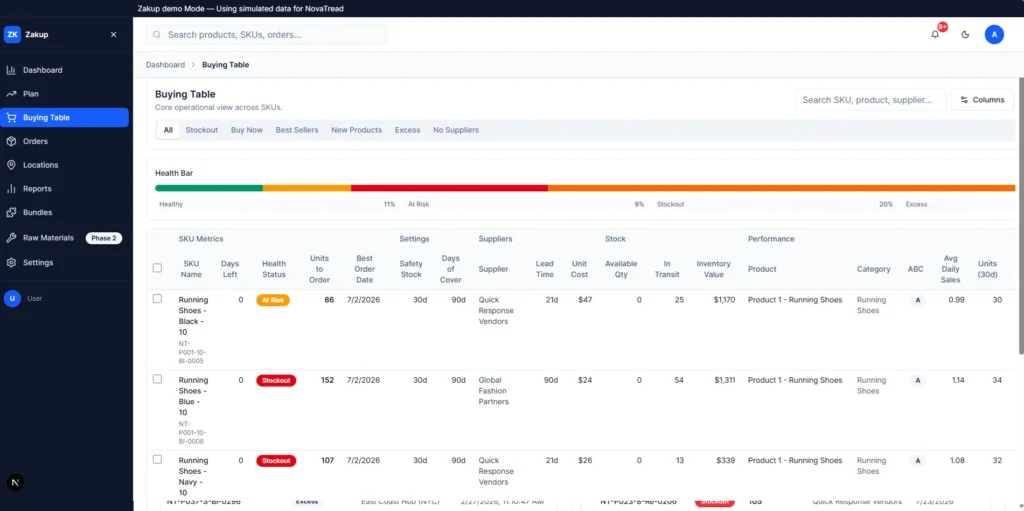
ZakUp’s customers are entrepreneurs and businesses that sell physical goods, including online stores, retailers, distributors, and small manufacturers managing hundreds or thousands of SKUs.
Ukraine became the startup’s first market. The team plans to expand next into other regional e-commerce ecosystems and, eventually, enter the global market.
Business Model
ZakUp operates on a B2B SaaS subscription model, with customers paying a monthly fee. Pricing depends on the size of the business and the number of SKUs managed.
Investment
The founders are currently funding ZakUp with their own capital and have invested approximately $25,000 to date.
They plan to raise a $250,000 pre-seed round to accelerate product development, expand the team, and scale sales.
Plans
“Our main focus right now is to complete the MVP, increase the number of pilot customers, and validate Product-Market Fit.
After that, we plan to scale the product into other markets, expand our integrations, and prepare for an international launch. Our goal is to make demand forecasting, inventory management, and working capital management tools accessible to every business that sells physical goods,” Kseniia concludes.
